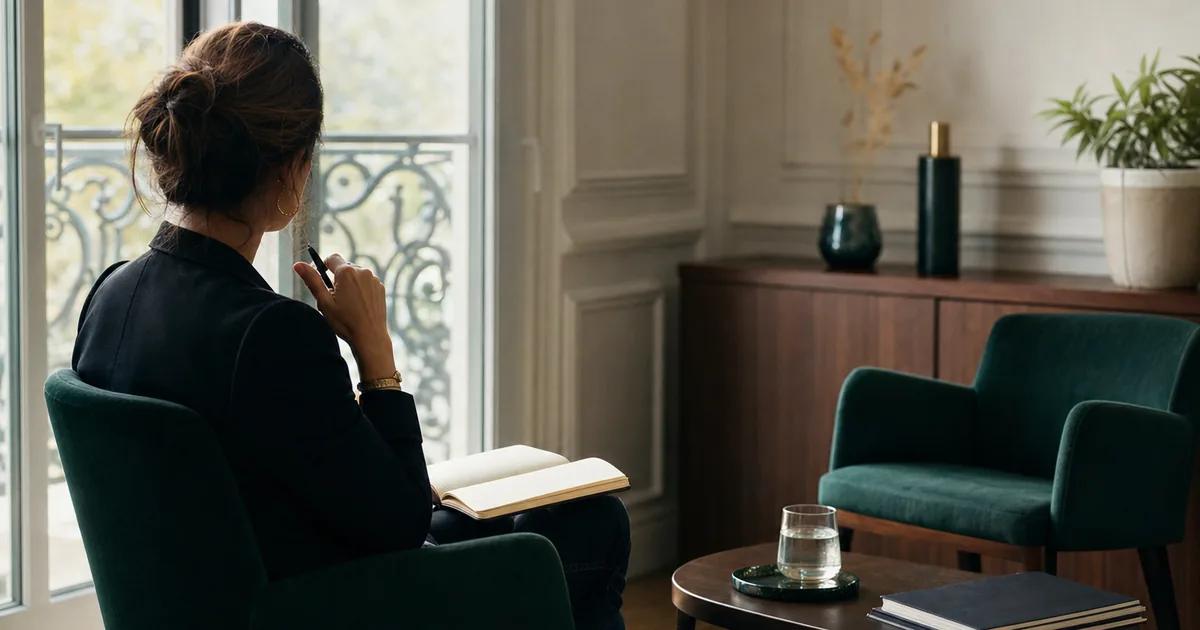

Supervision is often confused with an exam, with continuing education, or with therapy in disguise. It is none of these. It is a place where a professional coach comes to think about what they do, out loud, in front of someone whose job is to listen to practice.
The question deserves a straight answer, because the answer bears on the very quality of coaching. A coach works with who they are as much as with their methods. Periodically, they need a space in which to set down what is happening in their work, without having to justify themselves or perform.
Not an inspection, not a class, not a couch
Supervision is defined first by what it is not. It does not check the coach’s compliance with a protocol: it is not an inspection. It does not hand down knowledge: it is not a class. It does not treat the coach as a person: it is not therapy, even if it sometimes touches sensitive areas.
What it is, on the other hand, comes down to one demanding word: reflexivity. The supervisor brings no ready-made answers. They help the coach look at their own practice, spot what keeps replaying in it, name what put them in difficulty or in doubt. The frame is precise: a third party, protected time, confidentiality that holds. It is precisely that rigour of the frame that sets speech free.
Thinking about your practice alone has its limits. The coach stays inside their own blind spots, preferences and habits. An outside gaze, trained and caring, shifts that point of view. It is not about judging but about discerning: seeing more clearly where, alone, you were going round in circles.
What brings a coach to supervision
The reasons are rarely spectacular. Most often it is a diffuse unease, a situation that will not be filed away. A coach catches themselves avoiding a subject with a client, without quite knowing why. An engagement stalls, and the rational explanation is not enough to free it. A session leaves a lingering impression, as if something had played out beyond the visible field.
There are also the moments when the coach feels too involved. A client’s request resonates with their own history, and they no longer quite know whose emotion is in the room. The line between supporting and standing in becomes blurred. The frame, so clear elsewhere, quietly wavers.
Other signals belong to the craft itself. The relationship with a client becomes comfortable to the point of losing its edge, or tense to the point of blocking the work. An ethical question arises — about confidentiality, about an ambiguous request from the sponsor, about a conflict of loyalty between the organisation and the person being coached. The coach senses something is at stake, without the distance to settle it alone.
None of these situations is a sign of failure. They are the ordinary material of a living practice. Ignoring them, on the other hand, ends up weighing on the quality of the work and on the coach themselves.
What supervision makes possible
What this space allows is not measured in promises. First it offers distance. Setting a situation before a third party forces you to put it into words, and putting it into words already transforms it. What seemed confused comes into focus. What felt personal sometimes turns out to be a movement of the relationship — understandable, and workable.
Supervision then sharpens discernment. The coach learns to tell apart what comes from them, what comes from the client, and what comes from the system in which the coaching takes place. That lucidity does not make the craft simpler; it makes it more accurate. The coach chooses their interventions with more awareness, and holds their frame with more assurance.
Finally, it sustains you over time. Coaching exposes you, and sometimes wears you down. Having a regular place to think about your craft protects against isolation and keeps standards high. That is also how a coach stays reliable over the years, for those who entrust delicate work to them. It is in that spirit that the one-to-one supervision offered by Oxygen Coaching is designed — as an ongoing frame rather than an occasional resort.
None of this is guaranteed in advance. Supervision does not erase difficulties; it teaches you to cross them with more clarity. Its usefulness lies less in what it solves than in the quality of thinking it sustains.
A requirement, not an option
Choosing to be supervised is recognising that coaching practice, too, needs a space in which to be set down and thought about. Far from an admission of weakness, it is a mark of professional seriousness.
To understand the approach that guides this work, you can read about the background of Céline Thomas. And if the question of supervision is live for you, the simplest thing is to talk about it: let’s get in touch and explore the frame together.