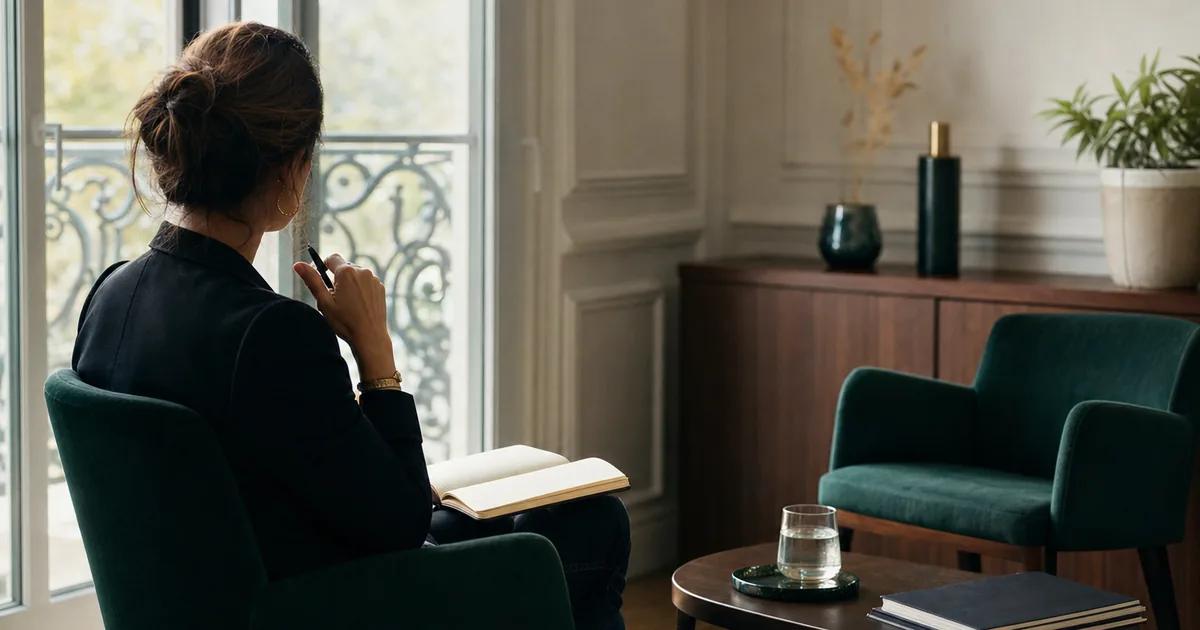

Two small turquoise sofas — turquoise is my favourite colour — facing each other, a rug between them. A low table with, within reach, water, a box of tissues, pencils, a few chocolates. Around the room, a few light pieces of furniture, shelves of books, ornaments, pretty objects, souvenirs of faraway journeys. On the wall facing sofa no. 1 I have hung my diplomas. My scarf and a notepad show that sofa no. 2 is my seat.
I care that the people I coach feel comfortable in my office, which is why I take great care over the decoration and the atmosphere. I make sure they feel welcomed, valued, safe, so that each of us — they and I — can do our best work.
Yet this is not only about pretty objects, comfort or decoration. My office is first and foremost, and exclusively, a workspace, and as such it is a device — studied, and precise.
In a dedicated professional space meant to receive people, nothing should be left to chance, because every element carries meaning: colours, materials, accessories, furniture. How they are arranged in relation to one another is fundamental. Low table: conversation; high table: work. Chair, armchair, sofa: three distinct statuses for whoever sits there, three different ways of calling on the heart, the body and the head.
In my office the sofas face each other, true, but not quite; I always sit slightly offset from my client, to avoid confrontation or a face-off, and to leave them free to look at me — or not.
The two sofas are identical and placed symmetrically on either side of the rug: they signal that speech can flow freely and without obstacle, in a relationship of trust and emotional safety, as equals. But the diplomas on the wall assert my standing as a professional, and the small table placed near the client, designed to meet their needs, signals that I am the one receiving them, to work with them.
GOING FURTHER — The impact of the physical environment on the coaching relationship: lessons from Supportive Design
Roger Ulrich’s work on Supportive Design and Evidence-Based Design shows that the physical environment plays a decisive part in the quality of human interactions in care settings. Although that research was carried out mainly in hospitals, its lessons transpose just as well to coaching practices. In his 2009 interview, Ulrich stresses the importance of grounding the design of care spaces in scientific evidence, and encourages taking empirical data into account to improve the experience of the people being cared for.
It is common sense to keep in mind that the layout of the space where a session takes place can influence the client’s wellbeing, the quality of the trusting relationship and, ultimately, the effectiveness of the coaching process. A well-designed coaching practice thus becomes a real lever that eases the client’s personal and professional development.
Key principles of Supportive Design applied to coaching
Reducing stress
Ulrich shows that the environment should minimise the stress factors likely to disturb the person being supported. In a coaching practice, that implies:
A calming atmosphere through soft, natural colours.
Controlled acoustics to ensure the confidentiality of what is said.
Balanced lighting, fostering a sense of comfort and safety.
Fostering interaction and social support
The design of the coaching practice should encourage a trusting relationship between coach and client. That can mean:
Furniture that avoids any impression of hierarchy (for instance comfortable armchairs rather than a desk separating the two people).
A layout that favours openness and listening, with no physical barrier.
A pleasant waiting room to set a calm tone before the session.
And above all, creating a frame of absolute confidentiality, essential for free and sincere speech.
Providing positive distractions
Ulrich points out that certain elements of the environment can improve people’s emotional state by drawing their attention away from stress or anxiety. In coaching, that translates into:
The presence of natural elements (plants, a view of a garden or an outdoor landscape).
Inspiring or symbolic artworks that evoke personal development and change.
A fluid, uncluttered layout that reinforces the feeling of clarity and focus, going as far as using materials and colours chosen for their positive psychological effect (wood and natural tones that support emotional wellbeing, for example).
Favouring natural light, which influences clients’ mood regulation and energy.
The coaching venue: a non-negotiable requirement
The choice of venue for a coaching session is an essential factor that directly influences the effectiveness of the work. To save time or for budget reasons, some coaches or clients may be tempted to hold sessions in unsuitable places, such as the client’s own offices, cafés or restaurants.
These choices raise real ethical and practical problems.
Coaching in the client’s offices is not acceptable: it creates an imbalance in the relationship, placing the client on familiar ground, in their professional setting, where they can be interrupted or influenced by their usual environment. A neutral venue is essential to allow distance and deep work. Cafés and restaurants are unsuitable: they guarantee neither confidentiality, nor calm, nor concentration. Ambient noise, interruptions and the presence of other people compromise the quality of the exchange and the impact of the sessions.
The excuse of lacking time or budget does not justify compromising on the environment: quality coaching rests on a structuring frame conducive to introspection. Investing in a proper venue is imperative to preserve the integrity of the process and ensure effective support.
I am still surprised, to this day, that these points are not spelled out in the profession’s codes of ethics.
TO TICKLE YOUR PRACTICE
- How would you describe the overall atmosphere of your coaching space?
- How do you think your clients perceive that space?
- Which elements of your environment help put clients at ease?
- What choices have you made about your coaching venue?
- On what criteria did you base those choices?
- What compromises have you accepted?
- How do those compromises affect the quality of the sessions?
- What limits do you feel in your current space?
- How does your working environment affect your own stance as a coach?
- How could you create a space more conducive to confidentiality and introspection?
- How could you involve your clients in improving their experience in your practice?
IN HONOUR OF MY SOFA, THROUGH NARRATIVE PRACTICE
Once upon a time there was a turquoise armchair named Murano, settled for years in a light-filled practice. Silent witness to the turmoil and triumphs of souls in search of themselves, its armrests, polished by time, seemed to murmur the stories it had gathered — an infinity of glittering fables. It was an armchair with an old soul, in which Céline, a passionate coach, sat every day to guide travellers towards unknown territories of their own hearts.
Céline was an architect of stories, a gardener of possibilities. Yet there had been three moments when her fire had almost gone out, her passions buried under compassion fatigue and the crushing weight of hostile norms. Murano remembered those nights when she had hesitated to close the door for good, eyes fixed on her books, companions at once mute and comforting.
One day, everything had changed. Céline had discovered narrative practice, those keys that open workrooms of alternative stories. She had thickened the outlines of her own legend, restored her dignity, and re-enchanted her life. “Even problems need love,” she would often murmur, like an incantation. The air of the practice then carried a subtle blend of scents: soft, floral jasmine, warm, heady spices, and a touch of incense that seemed to whisper ancient secrets.
Murano watched the changes. The sessions had taken on a new colour, vivid, sometimes sprinkled with humour. Céline handled words like shards of stars, summoning majestic baobabs to speak of resilience or forgotten archipelagos to explore the remote corners of the soul. Each session seemed a delicate weave of emotions, stories and metaphors, a tapestry in which light always found a way to pierce the dark.
Among her clients was Madame Pain-in-the-Neck, a blunt, outspoken sock who never minced her words — often words that had “fallen off the back of a lorry”. Over the sessions, Céline had managed to externalise her fully, giving this invasive personality a distinct and bounded place. From then on, Madame Pain-in-the-Neck stepped in as a critical ally, offering biting but constructive observations. “Some problems have big backsides,” she joked one day, setting off contagious laughter. The incense grew stronger then, as if the objects themselves rejoiced in these moments of shared humanity.
Murano belonged to a real life club, a silent but essential community. The Klimt clock, with its tree of life, paced the sessions with a patient, almost complicit ticking. The books, lined up or stacked, murmured among themselves like discreet sages. Even the lamp, casting a soft light, seemed to tilt its head, attentive. Together these objects formed a choir of vibrant stillness, each playing its part in the harmony of the place.
One day, Murano had allowed itself a confidence, beyond the silence imposed by its status as an object. “Céline, thanks to you, I am no longer just an armchair. I am a motionless storyteller, a discreet ally in this human dance you orchestrate.” It had never been a matter of flesh and blood, but rather of the essence of encounters, of the double listening that opened the way to buried stories. Céline had smiled, as if she had heard. Then she had murmured to herself, or perhaps to her faithful companion: “The faint traces we leave here now, you and I, may well become paths.”
And so, in that setting of light and scents, Murano and Céline went on lending an ear and thickening glittering stories, weaving dreams where once the chaos of problems had reigned.
As for you: if your sofa could whisper to the night, what secrets of soul and stars would it offer up to the silence?
GOING FURTHER
- Scientific paper: “A Theory of Supportive Design for Healthcare Facilities” by Roger S. Ulrich, published in 1997 in the Journal of Healthcare Design.
- Interview: “Roger Ulrich Discusses Evidence-Based Design In Healthcare”, published in 2009 in Healthcare Design Magazine, in which Ulrich discusses the evolution of his theory and its impact on the design of care environments.